
Section 8 Company Registration
What is Section 8 Company? – Companies Act, 2013
According to the Companies Act 2013, a Section 8 company is defined as an organization whose objectives are to promote arts, commerce, science, research, education, sports, charity, social welfare, religion, environmental protection, or other similar activities goals. These entities utilize their profits to achieve their mission and do not distribute dividends to their shareholders.Overview of Section 8 Company Registration
A Section 8 Company is a type of corporation established to promote non-profit activities, such as education, social welfare, environment preservation, arts, sports, charity, and more. This follows the provisions of the Companies Act 2013.
The essential purpose of registering a Section 8 Company is to encourage non-profitable goals, including but not limited to trade, arts, commerce, education, charity, environmental protection, sports research, and social welfare. To register a Section 8 Company, a minimum of two directors are required, and there is no requirement for a minimum paid-up capital to set up such a company.
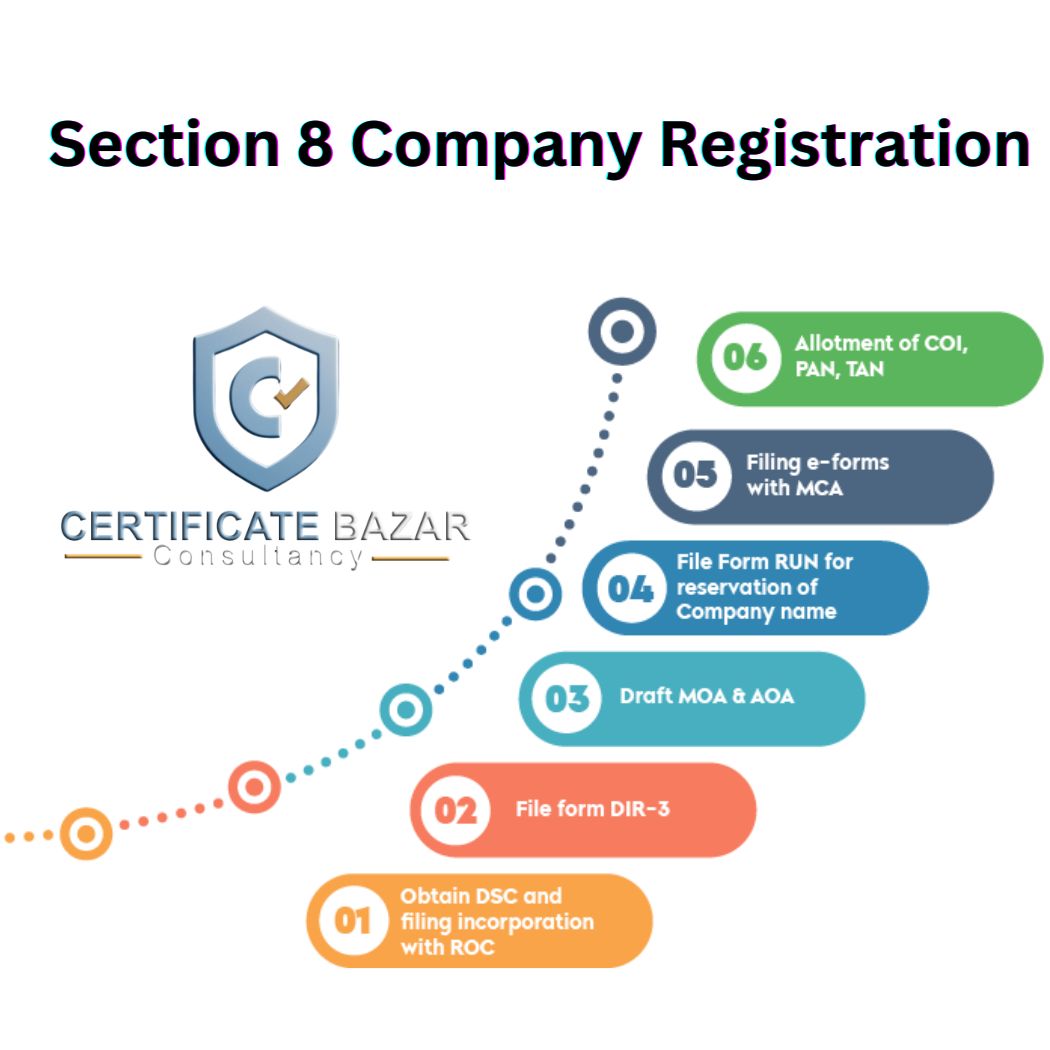
Key Points about Section 8 Company Act
- In India, Non-Governmental Organizations (NGOs) can be registered under the Registrar of Societies or as a non-profit entity under Section 8 Company of the Companies Act, 2013.
- Profit generated by Section 8 Companies cannot be used for purposes other than charitable objectives and cannot be distributed among shareholders.
- Section 8 Companies are similar to the erstwhile Section 25 Company under the Company Act 1956. As per the prevailing Company Act, these are now recognized as Section 8 Companies.
- Section 8 Companies are required to comply with the provisions of the Companies Act 2013. They are mandated to maintain books of accounts, file returns with the Registrar of Companies (ROCs), and comply with GST and IT Act.
- Any changes to the charter documents like the Articles of Association (AoA) and Memorandum of Association (MoA) require the government’s consent.
Benefits of Opening a Section 8 Company in India
Incorporating a Section 8 company in India offers numerous advantages, some highlighted below.
Tax Exemption
Section 8 companies registered under section 12AA of the Income Tax Act are eligible for a 100% tax exemption, as they utilize their profits for charitable purposes. This is a significant benefit as the profits generated by such entities are non-taxable.
No Minimum Capital Requirement
Unlike public limited companies, Section 8 entities do not have a minimum capital requirement. They can adjust their capital structure according to their growth, giving them more flexibility.
Separate Legal Entity
Section 8 companies have a separate legal identity and perpetual existence, just like other registered companies. This increases their credibility and provides them with more autonomy and legal standing.
Increased Credibility
Section 8 companies are subject to strict legal compliance frameworks, enhancing their credibility regarding legal standing. Unlike NGOs and trusts, Section 8 entities follow stringent compliances post-registration, making them more trustworthy.
No Title Required
Section 8 companies are free to choose a name that suits their liking during the registration process. Unlike other registered structures, they are not required to affix the term “Section 8” after their name.
A Section 8 company in India offers numerous benefits, including tax exemption, no minimum capital requirement, no need to pay stamp duty, separate legal identity, increased credibility, and no title required. These advantages make Section 8 companies attractive for entrepreneurs looking to start a business with a charitable or social cause.
Eligibility Criteria for Incorporation of the Section 8 Company
Specific eligibility criteria must be met to establish a Section 8 company in India.
- An Indian national or Hindu Undivided Family (HUF) can incorporate a Section 8 Company.
- The entity must have at least one director.
- The primary object of the Section 8 Company Act should be related to promoting art and science, sports, charitable activities, education, or providing financial assistance to individuals from lower-income groups.
These eligibility criteria ensure that the Section 8 Company operates to promote social welfare and contribute to the greater good of society.